
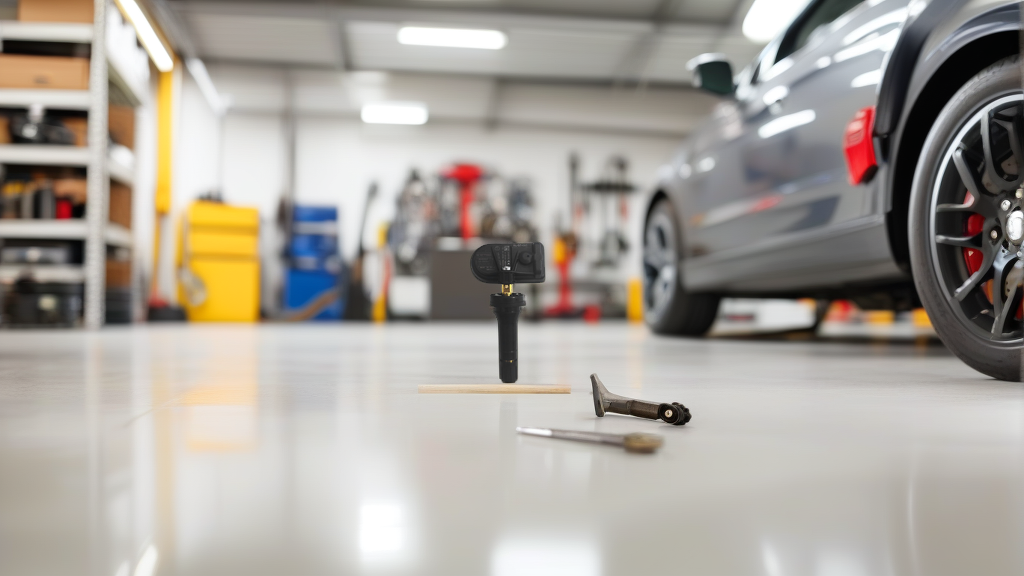
Understanding Leapmotor TPMS Relearn Requirements
Leapmotor, a rapidly growing Chinese EV brand, uses TPMS sensors sourced from Baolong Technology (BH-Sens). These sensors operate at 433MHz and require a relearn procedure whenever you replace a sensor, rotate tires, or the system loses synchronization after a battery swap. Unlike some older systems, Leapmotor does not support a simple button-based stationary relearn — you’ll need either a diagnostic tool or a specific driving sequence.
The three relearn methods available for Leapmotor are:
- OBD Relearn (preferred by technicians)
- Auto Relearn (drive-based, works for most models)
- Stationary Relearn (not supported on Leapmotor without a TPMS tool)
OBD Relearn Procedure (Most Reliable)
This method requires a TPMS programming tool that supports Leapmotor (e.g., Autel TS508, Bartec TPMS-950, or a dealer-level scan tool). The OBD relearn is the fastest and most accurate way to pair new sensors to the vehicle’s ECU.
Tools Needed
- TPMS diagnostic tool (Autel, Bartec, or equivalent)
- OBD-II cable (usually included with the tool)
- New or pre-programmed TPMS sensor (433MHz, compatible with Leapmotor)
Step-by-Step OBD Relearn
- Install the new sensor in the wheel. Ensure the valve stem nut is torqued to the manufacturer specification (typically 4–5 Nm for clamp-in sensors).
- Turn the ignition ON but do not start the engine. On most Leapmotor models, this means pressing the START button once without pressing the brake pedal (check your owner’s manual).
- Connect the TPMS tool to the OBD-II port (located under the dashboard, driver’s side).
- Select “Leapmotor” in the tool’s vehicle menu. If your tool doesn’t list Leapmotor, try selecting “Geely” or “BAIC” — some Leapmotor models share TPMS protocols with other Chinese OEMs.
- Choose “TPMS Relearn” or “Sensor Programming” from the tool’s function list.
- Follow the on-screen prompts — the tool will send a wake-up signal to each sensor in sequence (usually LF, RF, RR, LR). The tool may ask you to briefly place an activation trigger near each tire.
- Confirm the relearn once all four sensors are registered. The tool will display “Relearn Successful” or similar.
- Start the engine and verify the TPMS warning light turns off within 2–3 minutes of driving.
Note: If you’re using a pre-programmed sensor like the BL-ST-085 | BH-Sens 433MHz TPMS Tire Pressure Sensor | Fits Leapmotor | OE# 8083010BA01, the OBD relearn simply registers the sensor ID to the vehicle — no manual ID entry is required. This saves time compared to programmable sensors.
Auto Relearn Procedure (No Tools Required)
If you don’t have a TPMS tool, the auto relearn method works on most Leapmotor models. This method relies on the vehicle’s ability to automatically detect sensor IDs during driving.
Prerequisites
- All four sensors are installed and functioning (check with a trigger tool if possible)
- Tire pressure is set to the recommended PSI (usually 33–38 PSI for Leapmotor EVs)
Step-by-Step Auto Relearn
- Reset the TPMS system — On some Leapmotor models, you can do this by holding the TPMS reset button (often located under the steering wheel or in the glovebox) for 3 seconds until the warning light blinks. If no button exists, skip to step 2.
- Drive the vehicle at a steady speed above 25 mph (40 km/h) for 10–20 minutes without stopping.
- Monitor the TPMS warning light — it should turn off once all sensors are recognized. If the light remains on after 30 minutes of continuous driving, the sensors may not be transmitting correctly or the system requires OBD relearn.
- If the light stays on, attempt the procedure again with a full battery charge — Leapmotor EVs sometimes need higher auxiliary voltage for auto relearn to complete.
Limitations: Auto relearn may fail if you’ve replaced only one sensor, as the system expects to detect the new ID alongside three known IDs. In such cases, OBD relearn is more reliable.
Stationary Relearn – Not Supported on Leapmotor
Stationary relearn (using a magnet or deflation sequence) is common on Toyota, Honda, and some European brands. Leapmotor does not support this method. Attempting to trigger a stationary relearn by deflating tires or using a magnet will not work — you’ll only waste time. Stick to OBD or auto relearn.
Recommended TPMS Sensor for Leapmotor
If you’re replacing a failed sensor or equipping a new set of wheels, the BL-ST-085 | BH-Sens 433MHz TPMS Tire Pressure Sensor | Fits Leapmotor | OE# 8083010BA01 is a direct OE replacement. It’s pre-programmed to 433MHz and fits multiple Leapmotor models (including T03, C11, and C01). Key specs:
| Parameter | Value |
|---|---|
| Frequency | 433MHz |
| Type | Clamp-in (metal valve stem) |
| OE Number | 8083010BA01 |
| Compatibility | Leapmotor T03, C11, C01, and 4 other models |
| Pre-programmed | Yes — no need for cloning |
Installation tip: Always replace the valve stem core and cap when installing a new sensor. Use a torque wrench to tighten the sensor nut to 4–5 Nm — overtightening can crack the sensor housing.
FAQ
Can I use a universal TPMS sensor on my Leapmotor instead of the BH-Sens BL-ST-085?
Yes, but you’ll need a programmable sensor that supports 433MHz and is compatible with Chinese-brand protocols. Universal sensors from Autel or Schrader can work, but they require programming with a TPMS tool to match the Leapmotor system. The pre-programmed BL-ST-085 | BH-Sens 433MHz TPMS Tire Pressure Sensor | Fits Leapmotor | OE# 8083010BA01 eliminates that step.
How do I know if my Leapmotor needs a TPMS relearn?
The TPMS warning light (a tire cross-section with an exclamation mark) will remain illuminated after you’ve inflated tires to the correct pressure. If the light blinks for 60–90 seconds then stays solid, the system has lost communication with one or more sensors — a relearn is required.
Does the auto relearn work on the Leapmotor T03?
Yes, the T03 supports auto relearn. However, some early 2021 T03 models may require OBD relearn due to a software revision. If auto relearn fails after two attempts, use a TPMS tool to perform OBD relearn instead.