
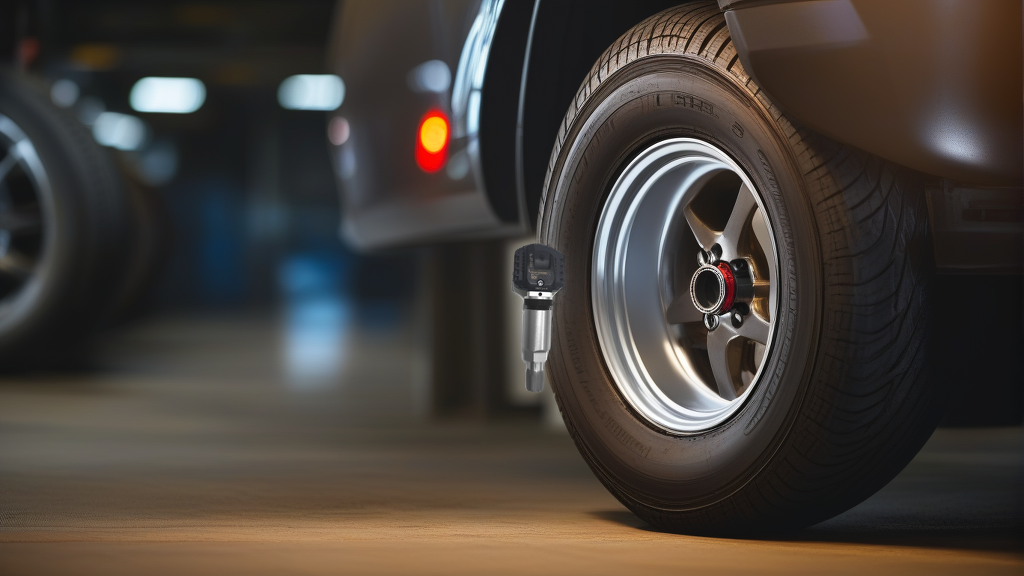
Why Lifan Owners Need to Pay Extra Attention to TPMS in Winter
Lifan vehicles, particularly models sharing platforms with Changan, often use 433MHz TPMS sensors that are sensitive to temperature swings. If you’re swapping to winter tires on a Lifan (X60, X70, or 820 sedan), the TPMS system expects consistent pressure readings. A sudden cold snap can cause the dashboard light to flash even if the tires are properly inflated—simply because the sensor’s battery voltage drops in low temperatures and the internal pressure reading shifts.
Many Lifan owners use a second set of wheels with winter tires. That’s fine, but you must ensure those wheels have compatible TPMS sensors. If your winter set lacks sensors, or if the sensors are dead or mismatched, the car will display a constant warning light. The fix is straightforward: install pre-programmed sensors that match your Lifan’s original frequency (433MHz) and OE numbers.
Step-by-Step: TPMS Handling During Tire Swap
1. Check Sensor Compatibility Before Mounting
Before you mount winter tires, verify the TPMS sensors on the winter wheels. Lifan models from 2010 onward typically use 433MHz sensors, but some early models may use 315MHz. The safest route is to use sensors that are pre-programmed to the OE numbers 3601010M01AA or 3601010M03—these cover most Changan-based Lifan applications. The BL-ST-030 | BH-Sens 433MHz TPMS Tire Pressure Sensor | Fits Changan | OE# 3601010M01AA, 3601010M03 is a direct-fit option that eliminates the need for programming at installation.
2. Inflate to Winter-Specific Pressures
Winter air is denser, and cold roads reduce tire flexibility. Lifan recommends checking pressures when tires are cold (not driven for at least 3 hours). A good rule: add 3–5 PSI above the summer recommendation to account for the temperature drop. For example, if your door sticker says 32 PSI, set winter tires to 35–37 PSI. This prevents false low-pressure warnings and maintains proper contact with icy pavement.
3. Reset the TPMS After Installation
Most Lifan models require a manual TPMS reset after a tire rotation or sensor replacement. The procedure varies by model year:
- Lifan X60 (2012–2018): Turn ignition to ON, press the TPMS reset button (near the steering column) for 3 seconds until the light blinks three times.
- Lifan X70 (2017–2020): Use the steering wheel menu to navigate to “Tire Pressure,” then select “Reset.”
- Lifan 820 (2015–2019): The system auto-learns after driving above 15 mph for 10 minutes. No button needed.
If the light stays on after 20 minutes of driving, one of your sensors may need replacement.
Temperature & Pressure: The Science Behind the Warning
Tire pressure drops roughly 1 PSI for every 10°F drop in ambient temperature. If you installed tires in a 70°F garage and the outside temperature is 20°F, each tire loses about 5 PSI. That’s enough to trigger a TPMS warning on most Lifan systems (which alert below 25% of recommended pressure).
Real-world example: A Lifan X70 with 35 PSI in a heated garage will read 30 PSI after sitting overnight at 25°F. That’s still within safe limits, but the TPMS might interpret it as a slow leak. The solution: inflate to 38 PSI indoors, then check again outdoors after the tires cool.
Pressure Adjustment Table (For Lifan Models)
| Outdoor Temperature | Recommended Cold Pressure (Winter) | Expected TPMS Behavior |
|---|---|---|
| Above 50°F | 32–34 PSI (follow door sticker) | Normal |
| 30–50°F | 35–37 PSI | May flash briefly at start |
| Below 30°F | 37–40 PSI | Brief warning, then clears |
| Below 0°F | 40–42 PSI (check max sidewall) | Possible persistent warning |
Note: Do not exceed the tire sidewall maximum pressure. For most Lifan OEM tires, that’s 44–50 PSI.
How to Store Spare TPMS Sensors
If you keep a set of summer wheels with sensors, storage matters for battery life. TPMS sensor batteries typically last 5–7 years, but improper storage can cut that in half.
Storage Do’s and Don’ts for Lifan TPMS Sensors
- Do store sensors in a cool, dry place (55–75°F, <50% humidity). A sealed plastic bag with a silica gel pack works well.
- Do keep sensors away from metal tools or batteries—metal contact can slowly drain the internal battery.
- Do remove the valve stem core if storing for more than 6 months to prevent seal degradation.
- Don’t store sensors in direct sunlight or near heaters—heat accelerates battery chemical decay.
- Don’t wrap sensors in aluminum foil or conductive materials (some people try this to block signals—it can short the sensor).
For long-term storage (over a year), consider removing the sensor from the wheel entirely and placing it in an antistatic bag. The BL-ST-030 | BH-Sens 433MHz TPMS Tire Pressure Sensor | Fits Changan | OE# 3601010M01AA, 3601010M03 is pre-programmed and sealed, so it’s ready to install after storage without additional programming.
Recommended Part for Lifan Winter Swap
If you need a replacement TPMS sensor for your Lifan during the winter swap, the BH-Sens BL-ST-030 (SKU: BL-ST-030) is a direct-fit option. It’s a 433MHz clamp-in sensor pre-programmed with OE numbers 3601010M01AA and 3601010M03, covering Changan-based Lifan models. No cloning or dealer programming is needed—install it, inflate, and the car will recognize it within a short drive.
BL-ST-030 | BH-Sens 433MHz TPMS Tire Pressure Sensor | Fits Changan | OE# 3601010M01AA, 3601010M03
FAQ
Can I use winter tires without TPMS sensors on my Lifan?
Technically yes, but the TPMS warning light will stay on permanently. In most regions, it’s legal to drive with the light on, but it will hide future real warnings (like a flat). It’s better to install sensors in the winter wheels—especially since pre-programmed options cost roughly the same as a single tire.
Why does my Lifan TPMS light blink after a tire swap?
A blinking TPMS light at startup usually means the system is learning new sensor IDs. It should stop after driving 10–15 minutes above 15 mph. If it stays blinking for over 30 minutes, one sensor may be faulty or not recognized—likely a frequency mismatch (315MHz vs. 433MHz).
How do I know if my Lifan’s TPMS sensor is 315MHz or 433MHz?
Check the original sensor’s label. If it’s a Changan-based Lifan (X60, X70, 820), it’s almost certainly 433MHz. Early Lifan models (pre-2010) like the 520 or 620 may use 315MHz. When in doubt, order a 433MHz sensor—most aftermarket options are backward-compatible.
Can I store TPMS sensors in the freezer to preserve battery life?
No. Extreme cold (below freezing) can actually damage the lithium battery chemistry and cause permanent capacity loss. Room temperature storage is best. A garage that stays above 40°F is fine; a deep freezer is not.