
—
Why Your Buick’s TPMS Light Comes On
Buick vehicles—from the Encore to the LaCrosse—use direct TPMS sensors mounted inside each tire. These sensors measure pressure and temperature, then transmit data via a 433MHz radio signal to the vehicle’s receiver module. When the warning light stays solid or flashes, it’s the system telling you something is wrong. There are three main categories of causes:
- Low tire pressure (most common, but often misdiagnosed)
- Dead sensor battery (inevitable over time)
- Signal interference (increasingly common with modern electronics)
Let’s walk through each one, with specific attention to how Buick vehicles behave.
—
Symptom #1: Tire Pressure Is Actually Low
Before buying any parts, check all four tires with a manual gauge. The TPMS light will illuminate when pressure drops 25% below the recommended PSI (usually around 30-35 PSI for Buick models). Fill to spec and drive for 10 minutes at speeds above 20 mph—the light should reset automatically.
If it doesn’t, or if the light returns within a day, you’re dealing with a sensor or battery issue.
—
Symptom #2: Dead Sensor Battery (The Most Common Cause)
Every TPMS sensor contains a non-replaceable lithium battery designed to last 5–7 years. Buick models from 2010–2018 are now entering this window. The battery doesn’t die suddenly—it degrades gradually. Here’s what you’ll notice:
- Intermittent warning light: The light comes on during cold mornings but goes off after driving.
- One tire consistently reads “–” or “0” on the dashboard display.
- All four sensors fail within a few months of each other (they were manufactured at the same time).
How to Confirm a Dead Battery
A standard TPMS scan tool (available at most tire shops) will show the sensor ID and battery status. A battery voltage reading below 2.4V means replacement is needed. On Buick vehicles, the system will typically flag the specific sensor with a “sensor not detected” code (e.g., C0750, C0755).
Why You Can’t Just Change the Battery
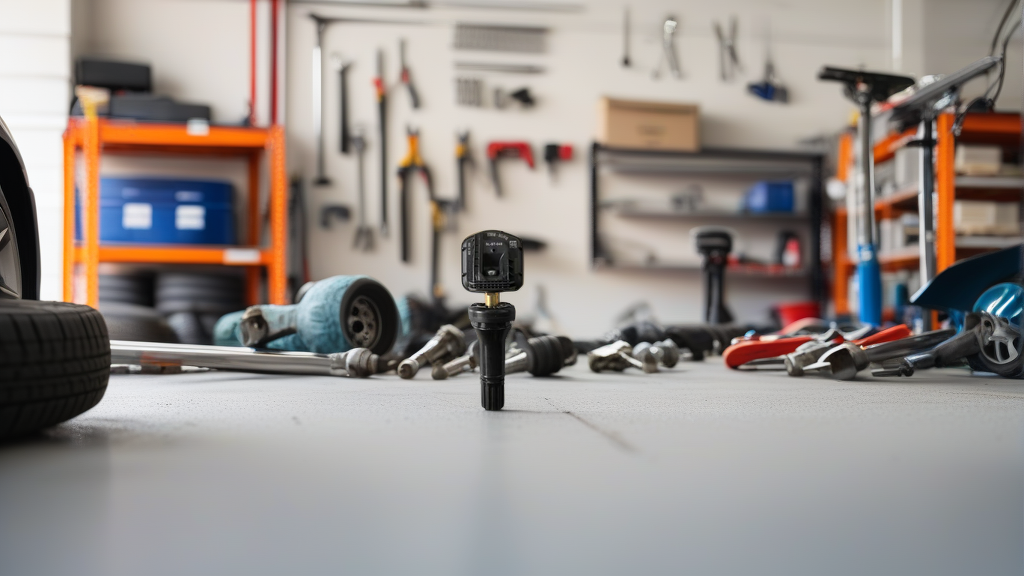
The battery is sealed inside the sensor housing. Attempting to open it destroys the sensor. The only fix is a new sensor. For Buick owners, the BL-ST-048 | BH-Sens 433MHz TPMS Tire Pressure Sensor | Fits Buick, Cadillac, Chevrolet, Nevo | OE# 13530661, 13533166, 13538565 is a pre-programmed 433MHz unit that matches OE part numbers 13530661, 13533166, and 13538565—so it communicates with the vehicle without dealer-level programming.
—
Symptom #3: Signal Interference
This is the most overlooked cause. Buick’s TPMS receiver module (usually located behind the glove box or near the center console) listens for weak radio signals from the sensors. Any strong 433MHz signal from nearby electronics can drown out the sensor transmissions.
Common Interference Sources in Buick Vehicles
| Source | How It Affects TPMS | Typical Symptoms |
|---|---|---|
| Aftermarket LED headlights or fog lights | Poorly shielded LED drivers emit RF noise on the 433MHz band | Random TPMS light, often at night or when lights are on |
| Dash cam with wireless backup camera | Camera transmitter operates near 433MHz | TPMS light comes on only when camera is active |
| USB phone charger plugged into 12V socket | Some cheap chargers radiate broadband RF noise | Intermittent loss of all four sensors |
| Aftermarket remote start system | Transmitter can interfere with sensor frequencies | Warning light during remote start use |
Diagnosing Interference
- Note when the light appears. Does it only happen with headlights on? Only when your dash cam is recording?
- Temporarily unplug aftermarket electronics. Remove USB chargers, turn off dash cams, disable LED light upgrades. Drive for 10 minutes. If the light goes out, you’ve found the culprit.
- Check for a metal window tint. Metallic tints can block the sensor signal from reaching the receiver. This is rare but possible on some Buick models with aftermarket tint.
If interference is confirmed, you may need to relocate the receiver module or replace the offending accessory with a better-shielded version.
—
Buick TPMS Sensor Fitment: What You Need to Know
Most Buick models from 2008–2020 use the same 433MHz sensor design, but there are two important details:
- Clamp-in vs. Snap-in: All Buick vehicles use clamp-in sensors (metal valve stem secured with a nut). The BL-ST-048 is a clamp-in design.
- Pre-programmed vs. Programmable: Pre-programmed sensors come with a preset ID that mimics the OE sensor. They work immediately after installation. The BL-ST-048 is pre-programmed to OE frequencies, so no special tool is required.
Example Compatibility Table
| Buick Model | Year Range | Compatible Sensor | Notes |
|---|---|---|---|
| Encore | 2013–2019 | BL-ST-048 | Check if 433MHz or 315MHz based on build date |
| Enclave | 2008–2020 | BL-ST-048 | 2018+ may require re-learn procedure |
| LaCrosse | 2010–2019 | BL-ST-048 | Early models use 315MHz; verify frequency |
| Regal | 2011–2020 | BL-ST-048 | Pre-programmed works for most trims |
| Verano | 2012–2017 | BL-ST-048 | Direct replacement for OE# 13530661 |
Always confirm your vehicle’s TPMS frequency (433MHz vs. 315MHz) by checking the driver’s door sticker or original sensor markings. Buick switched to 433MHz around 2010 for most models, but some early 2010s vehicles still used 315MHz.
—
Step-by-Step Troubleshooting Flow
If your Buick’s TPMS light is on right now, follow this order:
Step 1: Manual Pressure Check
Use a tire gauge. Fill all tires to the pressure listed on the door placard (not the tire sidewall). Drive for 10 minutes. Light still on? Proceed.
Step 2: Visual Sensor Inspection
Jack up each wheel. Look for damage to the valve stem (cracks, corrosion, leaking). If the valve stem is bent or corroded, the sensor must be replaced.
Step 3: Scan for Codes
Visit any tire shop or buy a $30 TPMS trigger tool. Scan each sensor. Note which ones respond and their battery voltage. Any sensor with voltage below 2.4V or that fails to respond is dead.
Step 4: Interference Test
Disconnect all aftermarket electronics. Drive for 15 minutes. If the light turns off, add accessories back one at a time until the light returns. That’s your interference source.
Step 5: Replace Faulty Sensors
If you have one or more dead sensors, replace them. The BL-ST-048 | BH-Sens 433MHz TPMS Tire Pressure Sensor | Fits Buick, Cadillac, Chevrolet, Nevo | OE# 13530661, 13533166, 13538565 is a reliable, pre-programmed option that avoids the trip to a dealership. Install requires breaking the tire bead, removing the old sensor, torquing the new sensor to 35–40 in-lbs (check your manual), and remounting the tire.
After replacement, Buick vehicles may need a “re-learn” procedure. On most models, you can do this yourself:
- Turn the ignition to ON (engine off).
- Use a magnet or TPMS tool at each valve stem in a specific order (left front, right front, right rear, left rear).
- The horn honks to confirm each sensor.
- Done.
Refer to your owner’s manual for exact steps—some 2018+ Buick models require the dealer tool.
—
Recommended Part
For Buick owners replacing a failed 433MHz sensor, the BL-ST-048 | BH-Sens 433MHz TPMS Tire Pressure Sensor | Fits Buick, Cadillac, Chevrolet, Nevo | OE# 13530661, 13533166, 13538565 is the best value option. It’s pre-programmed to OE specs, clamp-in design, and matches the original part numbers used by General Motors. No programming needed—just install and re-learn.
—
FAQ
How long do Buick TPMS sensor batteries usually last?
Most OEM and quality aftermarket sensors like the BH-Sens BL-ST-048 have a battery life of 5–7 years from the date of manufacture. If your Buick is from 2017 or earlier, you’re likely due for a replacement. Cold climates can shorten battery life by 6–12 months.
Can I replace just one TPMS sensor on my Buick?
Yes, but it’s not recommended if other sensors are 5+ years old. Replacing all four at once ensures they have the same battery life and prevents repeat labor costs. If you replace only one, the system will work, but the remaining three will likely fail within a year or two.
Why does my Buick TPMS light flash for 60 seconds then stay on?
That flashing pattern indicates the system has detected a fault—typically a missing or malfunctioning sensor. It’s not a low-pressure warning. You’ll need to identify which sensor is not communicating using a scan tool. Interference can also cause this behavior.
Will a 315MHz sensor work on my 433MHz Buick?
No. The frequency must match exactly. Using a 315MHz sensor on a 433MHz system (or vice versa) will result in no communication. Always check your Buick’s original sensor frequency before purchasing a replacement. The BL-ST-048 is 433MHz only.