
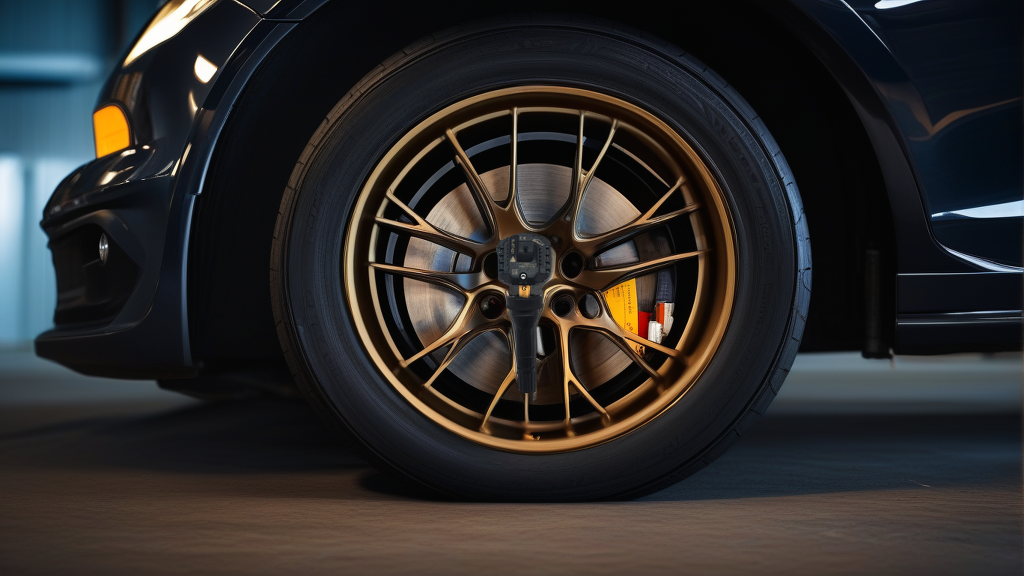
What the MINI JCW Coupe Actually Needs
The R58-generation JCW Coupe runs a direct TPMS system: a battery-powered sensor bolted to the valve stem inside each wheel, transmitting pressure data to a receiver the car reads on startup and while driving. Two specs matter more than anything else on the packaging:
- Frequency. Most builds use 433MHz. Some markets and model years use 315MHz instead. A 315MHz sensor will sit in a 433MHz car and never be seen by the receiver — no fault code that says “wrong frequency,” just a permanent TPMS warning.
- Relearn method. Depending on build, the car either auto-learns after a drive cycle above a certain speed, or needs a scan tool / trigger procedure to register new sensor IDs.
Battery life on a factory sensor is typically the better part of a decade. When one dies, the others in the set are usually within a year or two of the same age.
The Part Nobody Tells You: OEM Sensors Aren’t Made by MINI
MINI doesn’t manufacture TPMS sensors. Neither does BMW. They’re built by Tier 1 suppliers — Huf, Schrader, Baolong Technology and a handful of others — to the automaker’s specification, then boxed with a logo.
This matters because it breaks the usual logic. “Aftermarket” doesn’t automatically mean lower quality. It means not sold in the automaker’s box. The same factory that builds the OEM sensor often builds the aftermarket version on the same line, with the same battery and the same RF chip, sold under a different part number.
| Factor | OEM / OES | Quality Aftermarket | Cheap Generic |
|---|---|---|---|
| Who makes it | Tier 1 to automaker spec | Often the same Tier 1 | Unknown / white-label |
| Programming | Pre-programmed to MINI protocol | Pre-programmed or programmable | Often “universal,” needs a tool |
| Valve type match | Exact | Usually exact (clamp-in or snap-in) | Frequently one-size-fits-all |
| Price per sensor | Highest | 30–60% less | Lowest |
| Warranty | 12–24 months | 12–24 months typical | 30–90 days |
| Real-world lifespan | 7–10 years | 5–9 years | Unpredictable |
| Best for | Warranty-sensitive cars | Daily drivers out of warranty | Emergency use only |
When OEM Is Actually Worth the Money
Be honest with yourself about which of these applies:
- The car is under warranty or an extended service contract. Installing non-OEM parts gives a dealer an easy reason to push back on a related claim. Pay the premium until coverage ends.
- You’ve already had two aftermarket sensors fail a relearn. At that point you’re paying for labor twice. Buy the OEM part and stop the bleeding.
- You’re maintaining a low-mileage or collector example. Originality has value on a JCW Coupe, and the price gap on four sensors is small relative to that.
- A shop is doing the work and won’t install customer-supplied parts. Many won’t, and that’s their call.
When Aftermarket Is the Smarter Buy
- The car is out of warranty and driven regularly.
- You’re building a second wheel set for winter or track use and need four sensors, not one.
- Two or more sensors have died at once and the OEM quote is pushing four figures installed.
- You’re comfortable cross-referencing an OE number — which takes about five minutes.
For most JCW Coupe owners past the warranty window, aftermarket is the right call. The savings on a set of four typically covers the mounting and relearn labor entirely.
The Fitment Trap: Match the OE Number, Not Just the Frequency
Here’s where buyers get burned. Two sensors can both be 433MHz, both clamp-in, both pre-programmed — and still not interchange, because the protocol inside the chip is set for a different vehicle platform.
A good example from our own catalogue: BL-ST-021 | BH-Sens 433MHz TPMS Tire Pressure Sensor | Fits Im, MG, Rising, Roewe | OE# 10290600, 10625492, 10718213 — the BH-Sens BL-ST-021, a 433MHz clamp-in, pre-programmed sensor built by Baolong Technology. It carries OE references 10290600, 10625492, 10718213 and 11205327, and covers 59 dedicated OE fitments across Im, MG, Rising and Roewe platforms. It is not an R58 MINI part. But it demonstrates exactly the standard you should demand when shopping for your JCW: a named Tier 1 manufacturer, published OE cross-references, a stated frequency, and a stated valve type. If a listing has none of those, walk away.
Before you order anything, verify:
- The frequency stamped or listed for your build.
- The OE number on the sensor you’re removing — match it.
- Clamp-in versus snap-in valve type.
- Whether your car auto-learns or needs a scan tool.
- The seller’s warranty length and return policy on electronic parts.
Recommended Part
BL-ST-021 | BH-Sens 433MHz TPMS Tire Pressure Sensor | Fits Im, MG, Rising, Roewe | OE# 10290600, 10625492, 10718213 — BH-Sens BL-ST-021, 433MHz clamp-in pre-programmed TPMS sensor with OE cross-references 10290600, 10625492, 10718213 and 11205327. Use it as your benchmark for what a properly documented aftermarket TPMS listing looks like, and apply the same checklist when sourcing the sensor for your JCW Coupe. Torque the retaining nut to the figure in your service manual — don’t guess.
FAQ
Do aftermarket TPMS sensors last as long as OEM?
A sensor from a known Tier 1 supplier usually runs 5–9 years versus roughly 7–10 for the factory part. The gap is mostly battery chemistry and how conservatively the transmit interval is set. Sensors from unknown white-label sellers are a coin