
Read the Light Before You Touch a Gauge
Every CAMARO built in the last several generations runs a direct TPMS: a battery-powered sensor strapped to each valve stem, broadcasting pressure and temperature to a receiver that feeds the body control module. That means the dash can show you four individual pressures — and that display is your best diagnostic tool.
Two behaviors mean two different things:
- Solid light, pressures displayed and low → air pressure problem. Inflate to the door-jamb placard and drive a few miles.
- Light flashes for roughly 60–90 seconds, then goes solid → system fault. A sensor is missing, dead, unlearned, or the receiver has a stored code. Chasing tire pressure here wastes time.
The Common Causes, Mapped to Symptoms
| What you see | Most likely cause | Fast check |
|---|---|---|
| One corner reads blank or “—“, other three normal | Failed sensor, dead battery, or no RF signal from that wheel | Scan that wheel’s ID; swap the wheel position and recheck |
| All four blank after new wheels or tires | Sensors not relearned to the vehicle | Perform the relearn procedure |
| Light flashes then stays on, pressures read fine | Stored DTC — sensor missing, duplicate ID, or receiver fault | Scan the TPMS/BCM module |
| One tire reads 5–10 psi off consistently | Sensor drift, wrong sensor ID mapped to that corner, or a bad gauge | Cross-check with a known-good gauge |
| Light appears on cold mornings, clears after 10 minutes | Weak sensor battery or normal cold-weather pressure drop | Check pressures cold; note ambient temperature |
| Light appears only at highway speed | Sensor dropping out under load — usually a dying battery | Log signal strength with a scan tool during a road test |
Roughly 1 psi is lost per 10°F of temperature drop, so a 30°F overnight swing can absolutely trip a light on a tire that was fine yesterday. Rule that out before you condemn a sensor.
Dead Sensor Battery: What It Looks Like Before It Quits
Each sensor has a lithium cell potted inside the housing. There is no replacement procedure — when the cell goes, the sensor goes. Expect 7–10 years of service, less in hot climates.
The failure is rarely sudden. Watch for these stages:
- Intermittent dropouts. One corner goes blank for a few minutes, then returns. Most common in cold weather, because cell voltage sags at low temperature.
- Speed-dependent dropouts. The sensor transmits but the receiver loses it at highway speed. Scan tools will show a weak or inconsistent signal from that ID.
- Permanent loss. The corner stays blank and no relearn will bring it back.
If a scan tool shows the sensor ID present but signal strength weak, or the sensor stops responding to a wake-up tool, replace it. Do not try to “reprogram” a dead sensor — you’ll just burn an hour.
Signal Interference: The Diagnosis Most People Skip
433 MHz and 315 MHz are shared, unlicensed bands. Plenty of aftermarket electronics sit right on top of them.
Check these when a sensor tests good but the vehicle won’t read it:
- Dash cams, USB chargers, and phone mounts plugged into the 12V socket. Unplug everything and retest.
- LED retrofit bulbs and HID ballasts — cheap drivers are noisy across a wide band.
- Metal valve caps. They don’t block RF, but they corrode and seize, and they suggest someone has been in there.
- Tire sealant and foam inserts — some formulas coat the sensor antenna.
- Aftermarket wheels with metal stems that shield the sensor body.
- A second vehicle in the bay broadcasting on the same frequency, or a sensor left transmitting in a parts box nearby.
- Duplicate or cloned IDs after a wheel rotation — two sensors with the same ID will fight each other and produce ghost readings.
Diagnosis method: park the car away from the shop, remove accessories one at a time, and watch the scan tool’s live signal data. Interference disappears the moment you remove the source.
Frequency and Programming: Where Most Wrong-Part Orders Start
Two specs decide whether a sensor will work, and neither is negotiable.
- Frequency. North American-market vehicles generally use 315 MHz; many export and Chinese-market vehicles use 433 MHz. Fitting the wrong band means the sensor transmits into nothing.
- Programming. Blank sensors need to be programmed to the vehicle’s protocol. Pre-programmed sensors carry a fixed OE-compatible ID set and must match your application exactly.
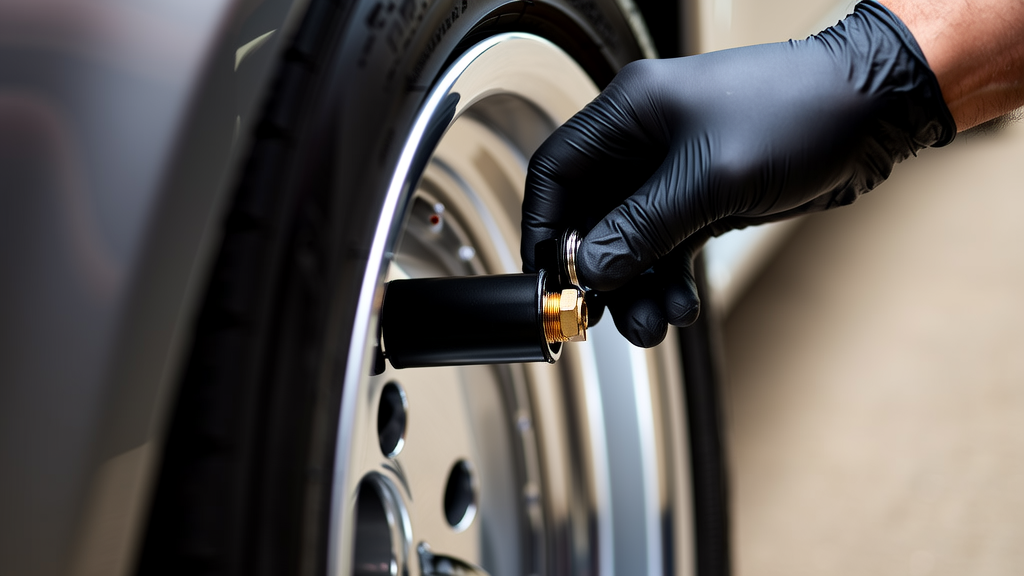
The BH-Sens BL-ST-046 is a useful example of how tight the match has to be — it’s a clamp-in, pre-programmed 433 MHz sensor built to OE reference 3778080HA01 for Hongqi applications. It’s the right part for that fitment and the wrong part for a North American Camaro, which is exactly why you verify frequency and OE cross-reference before ordering rather than after the tire is mounted. You can see the full spec sheet here: BL-ST-046 | BH-Sens 433MHz TPMS Tire Pressure Sensor | Fits Hongqi | OE# 3778080HA01.
Relearn Mistakes That Mimic Hardware Faults
A Camaro that just had tires swapped and now shows a flashing light usually isn’t broken — it’s unlearned. Sensors don’t automatically re-pair when they change corners. Use the relearn procedure specified for your vehicle (tool-based or drive-cycle, depending on the system) and confirm the horn chirp or the dash confirmation before assuming a sensor failed. If a relearn refuses to complete on a single corner, that wheel is your problem.
Recommended Part
If your application calls for a 433 MHz clamp-in, pre-programmed sensor with OE cross-reference 3778080HA01, the BH-Sens BL-ST-046 (SKU BL-ST-046) is a direct-fit option: BL-ST-046 | BH-Sens 433MHz TPMS Tire Pressure Sensor | Fits Hongqi | OE# 3778080HA01. Verify your vehicle’s frequency and OE number against the part you remove before ordering — and if you’re working on a Camaro, confirm the band first, because 433 MHz is not what most North American cars run.
FAQ
How long do Camaro TPMS sensors last?
Typically 7–10 years, depending on climate and mileage. Heat is the main killer, so cars in the Southwest often see failure at the short end of that range. Replace sensors as sets when one fails if the others are the same age — you’ll avoid doing the job again in six months.
Can I just ignore the TPMS light?
No. Even if you check pressures manually, a flashing light means the system can’t warn you about a slow leak or a blowout risk. It’s also an inspection failure item in many states. A solid light with correct pressures is often an unlearned or dying sensor, which is cheap to fix now and annoying later.
Why does my TPMS light come on only in cold weather?
Cold air lowers tire pressure — about 1 psi per 10°F — and cold also sags sensor battery voltage. If the light appears on frosty mornings and clears as the tires warm, start by setting pressures cold to the door placard, then look at sensor age if it keeps recurring.
Do aftermarket sensors need to be programmed?
Pre-programmed sensors carry a fixed, OE-compatible ID set and only need a vehicle relearn. Blank sensors must first be programmed to the correct protocol and frequency with a TPMS tool. Never buy a blank sensor unless you have the tool and the correct protocol data for your vehicle.