
Understanding Buick TPMS Relearn Basics
If you’re a Buick owner or a shop servicing Buick vehicles, you’ve likely encountered the dreaded TPMS warning light after swapping tires or installing new sensors. Every Buick equipped with a Tire Pressure Monitoring System (TPMS) — which includes nearly all models from 2008 onward — requires a relearn procedure after sensor replacement, tire rotation, or battery change in the sensors.
The relearn process tells the vehicle’s ECU the unique ID of each wheel-mounted sensor, matching it to the correct corner (LF, RF, RR, LR). Without a successful relearn, the TPMS light stays illuminated, and you lose pressure monitoring.
Buick uses two main TPMS protocols depending on the model year:
- Direct TPMS (2008–2019): 433MHz frequency sensors with individual IDs.
- Indirect TPMS (some 2020+ models): Uses ABS wheel speed sensors — no sensor IDs to program, so no relearn needed (but these are rare on Buicks).
This guide focuses on the direct TPMS systems found on Buick models like the Enclave, LaCrosse, Regal, Envision, and Encore.
Tools You’ll Need for a Buick TPMS Relearn
Before starting, gather the correct equipment. The method you choose determines which tools are necessary.
| Tool | Purpose | Required For |
|---|---|---|
| TPMS activation tool (e.g., Autel TS508, Bartec Tech400) | Triggers each sensor to send its ID | OBD relearn, stationary relearn |
| OBD TPMS scan tool (e.g., Autel MaxiTPMS) | Initiates relearn and writes IDs via OBD port | OBD relearn only |
| Magnet (strong rare-earth type) | Activates sensor in older Buicks (2008–2011) | Stationary relearn on some models |
| Tire pressure gauge | Verify pressures before relearn | All methods |
| Vehicle owner’s manual | Confirm relearn procedure for your specific model year | Optional but recommended |
Important: Many Buick models from 2012 onward require a dedicated TPMS tool for the stationary relearn — a simple magnet won’t work. Check your manual or use the OBD method for best results.
Method 1: Auto Relearn (No Tools Required)
The auto relearn, also called “drive-learn,” is the simplest method. It works on Buick models built between 2008 and 2013, and some 2014–2016 models. The vehicle automatically learns the sensor IDs while you drive.
Step-by-Step Auto Relearn
- Set all tires to the recommended pressure (found on the driver’s door jamb sticker). Use an accurate gauge.
- Start the engine and let it idle for 10 seconds.
- Drive the vehicle at a steady speed between 20–40 mph for 10–15 minutes. Avoid aggressive turns or hard braking.
- Watch the TPMS light — it should blink for 60–90 seconds, then turn off. If it stays solid, the relearn failed.
- Check each tire pressure on the dashboard display. If all four show correct pressure, the relearn is complete.
When auto relearn fails: Common reasons include a flat battery in one sensor, a sensor that’s more than 3 feet from the receiver (e.g., a full-size spare in the trunk), or the vehicle is a 2014+ model that doesn’t support auto relearn. In those cases, move to Method 2 or 3.
Method 2: OBD Relearn (Fastest and Most Reliable)
This method uses a TPMS scan tool connected to the OBD-II port. It’s the preferred approach for professional shops and works on all Buick models from 2008 onward. The tool reads each sensor’s ID and writes them to the ECU in under 2 minutes.
Step-by-Step OBD Relearn
- Verify all four sensors are installed and inflated to the correct pressure.
- Connect your TPMS tool (e.g., Autel TS508) to the OBD-II port under the dashboard.
- Select “Buick” from the vehicle menu, then choose the correct model and year.
- Trigger each sensor by holding the tool near the tire valve stem (within 2 inches). The tool will display the sensor ID and location.
- Follow the tool’s on-screen prompts to write the IDs to the ECU. This usually takes 10–20 seconds.
- Disconnect the tool and start the engine. The TPMS light should turn off immediately. If not, drive for 1–2 minutes to confirm.
Pro tip: Always trigger the left front sensor first, then right front, right rear, and left rear in that order. Some Buick models are sensitive to the sequence.
Method 3: Stationary Relearn (Magnet or Activation Tool)
The stationary relearn requires you to activate each sensor at the wheel, and the vehicle learns the IDs in a specific sequence. This method works well on 2008–2011 Buicks with a magnet, and on 2012–2019 models with a TPMS activation tool.
For Older Buicks (2008–2011) — Magnet Method
- Park the vehicle and turn the ignition to ON (engine off).
- Press and release the lock and unlock buttons on the key fob simultaneously for 5 seconds. The horn will chirp once.
- Hold a strong magnet (at least 10 lb pull) against the valve stem of the left front tire for 5–10 seconds. The horn will chirp once.
- Repeat for the right front, right rear, and left rear tires in that order. The horn chirps after each successful activation.
- Turn the ignition OFF. The TPMS light should turn off when you restart the engine.
For Newer Buicks (2012–2019) — Activation Tool Method
- Turn the ignition to ON (engine off).
- Press the lock and unlock buttons on the key fob simultaneously for 5 seconds. The horn chirps once.
- Use a TPMS activation tool (set to 433MHz) to trigger the left front sensor. Hold the tool against the tire sidewall near the valve stem. The horn chirps once.
- Repeat for right front, right rear, and left rear in order.
- Turn the ignition OFF. The horn chirps twice to confirm completion.
Note: If the horn doesn’t chirp after a sensor trigger, move the tool closer to the valve stem or try a different angle. Dead sensors need replacement first.
Recommended Part for Buick TPMS Replacement
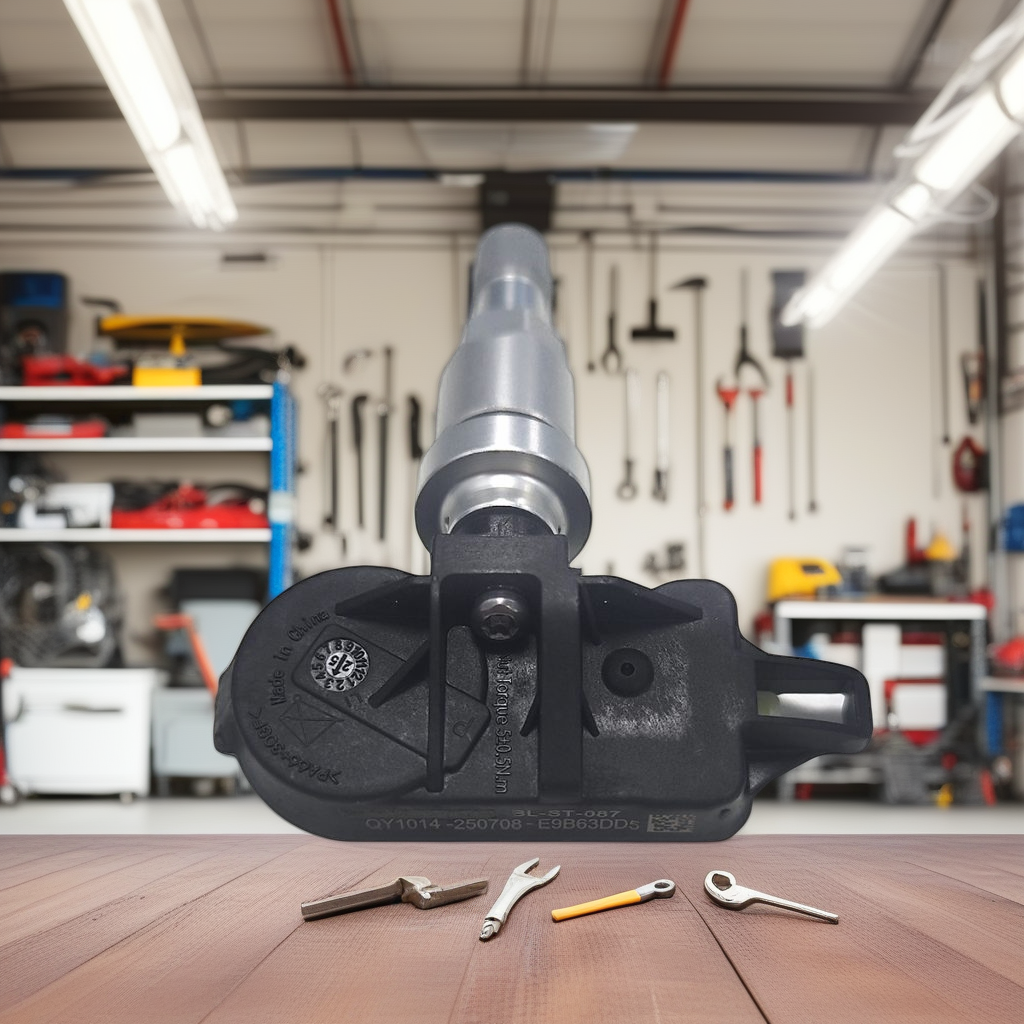
If you’re replacing a faulty sensor, consider using a pre-programmed option that matches your Buick’s frequency and fitment. For example, the BL-ST-087 | BH-Sens 433MHz TPMS Tire Pressure Sensor | Fits Buick, Chevrolet | OE# 26670584 is a 433MHz clamp-in sensor pre-programmed to work with many Buick models (including Enclave, LaCrosse, Regal) and Chevrolet vehicles. It comes with the correct valve stem and nut, and it’s already set to the right frequency — no cloning needed. Just install it and run a relearn.
Common Buick TPMS Relearn Issues and Fixes
- Horn doesn’t chirp during stationary relearn: Check that the key fob battery is good. On some 2013–2015 models, you must press the lock and unlock buttons within 5 seconds of turning the ignition ON.
- OBD tool fails to connect: Ensure the tool’s firmware is updated. Buick models after 2016 may require a CAN-compatible tool.
- Auto relearn never completes: The vehicle may require a sensor ID reset via OBD first. Some Buicks need a “reset” command before the drive-learn works.
- Sensor IDs show “unknown” on tool: The sensor may be damaged or have a dead battery. Replace it before proceeding.
FAQ
How often do I need to do a TPMS relearn on my Buick?
You need a relearn every time you replace a TPMS sensor, rotate tires (on models that don’t auto-detect position), or install new wheels. Some Buick models (2010–2013) also require a relearn if the battery is disconnected.
Can I use a universal TPMS sensor on my Buick?
Yes, but only if it’s programmed to the correct 433MHz frequency and has a compatible ID format. Many universal sensors require a cloning tool to copy the original sensor’s ID. Pre-programmed sensors like the BH-Sens BL-ST-087 simplify this — they come ready to install on Buick and Chevrolet applications without extra programming.
My Buick’s TPMS light is flashing after a tire rotation. What’s wrong?
A flashing TPMS light typically means the system is in “learn mode” or a sensor is not communicating. If you just rotated tires, the vehicle may have lost track of which sensor is where. Run an OBD relearn to reassign the positions. If the light continues flashing, one sensor may have failed during the rotation (e.g., the valve stem was damaged).
Does the auto relearn method work on a 2018 Buick Enclave?
No. The 2018 Enclave (and most Buicks from 2014 onward) does not support auto relearn. You must use either an OBD tool or a stationary relearn with an activation tool. The owner’s manual for that model specifically states that a TPMS tool is required.