
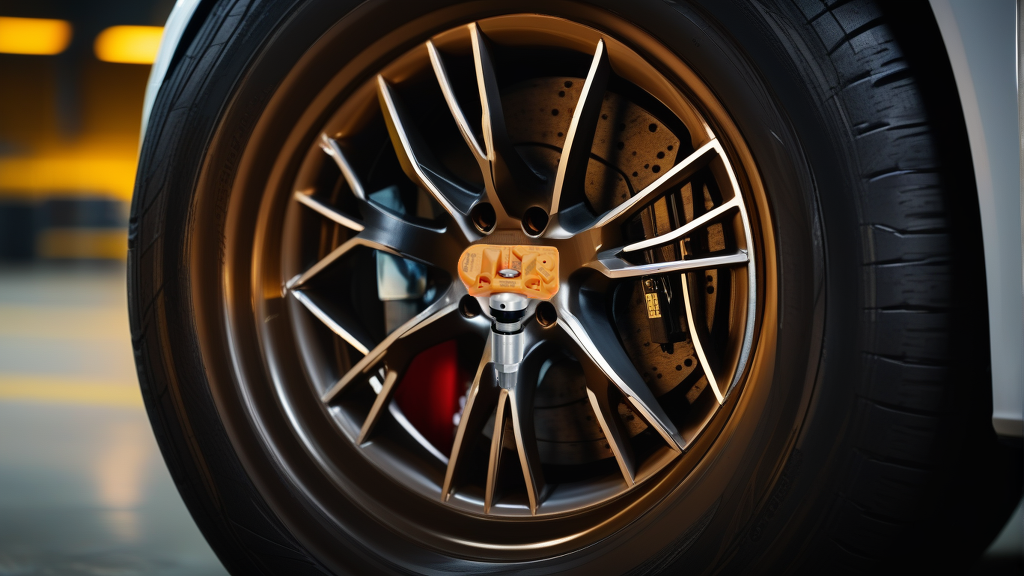
Understanding TPMS Relearn on GHIBLI
GHIBLI (Maserati) models from 2014 onward use a direct TPMS system that monitors tire pressure via sensors mounted inside each wheel. When you replace or rotate sensors, the vehicle’s ECU must “relearn” the new sensor IDs. Without this step, the TPMS light stays on, and the system cannot alert you to low pressure.
GHIBLI supports three relearn methods. The best choice depends on your tools and time.
Method 1: Auto Relearn (Drive-Away Relearn)
This is the simplest method, requiring no special tools.
Steps:
- Inflate all tires to the recommended cold pressure (found on the driver’s door jamb).
- Start the engine and drive the vehicle above 30 mph (50 km/h) for at least 10 minutes, but ideally up to 20 minutes.
- The system will automatically detect and register the new sensor IDs during driving.
Success rate: Moderate. It works reliably only if the sensors are pre-programmed to the correct frequency (433MHz for GHIBLI). If your sensors are not pre-programmed or the vehicle has been stationary for weeks, the auto relearn may fail. Also, this method does not work if the vehicle is in “transport mode” or has a dead sensor battery.
When to use: Good for quick tire rotations or if you have no TPMS tool. Not recommended for sensor replacements.
Method 2: OBD Relearn (Tool-Based)
This is the gold standard for GHIBLI. You need a compatible TPMS programming tool (e.g., Autel TS508, Bartec Tech400SD, or ATEQ VT56). The tool communicates with the vehicle’s OBD-II port to trigger the relearn.
Steps:
- Connect the TPMS tool to the vehicle’s OBD-II port (located under the dashboard, driver’s side).
- Select “GHIBLI” and the model year (2014–2020, depending on your vehicle).
- Choose “Relearn” or “Sensor ID Registration.”
- Follow the tool’s prompts. Most tools will ask you to activate each sensor by placing the tool near the tire sidewall (within 2 inches) and pressing the trigger. Activate in this order: LF, RF, RR, LR.
- After all four sensors are activated, the tool sends a “learn” command to the ECU.
- The horn will beep once or the TPMS light will blink, then turn solid. This confirms the relearn is complete.
Time: 3–5 minutes.
Why it’s best: It works every time, even with aftermarket sensors like the RDE027V21 | BH-Sens 433MHz TPMS Tire Pressure Sensor | Fits Alpina, BMW, Mini | OE# 36106856209, 36106881890, 6855539, which are pre-programmed to GHIBLI’s 433MHz frequency. OBD relearn also allows you to program new sensor IDs without driving.
Method 3: Stationary Relearn (Menu-Based)
Some GHIBLI models allow a stationary relearn via the infotainment settings.
Steps:
- Turn the ignition to ON (engine off).
- Navigate to: Settings → Vehicle → TPMS → Relearn.
- The vehicle will enter “Learn Mode” (the TPMS light will flash slowly).
- Using a TPMS activation tool (or a strong magnet for older models), activate each sensor in the correct sequence (LF, RF, RR, LR).
- After activating all sensors, exit the menu. The TPMS light should turn off after a short drive.
Note: This method is less common on GHIBLI. Many owners find it unavailable on 2016+ models. If your menu does not have a “Relearn” option, use the OBD method.
Tools You Need for GHIBLI TPMS Relearn
| Tool Type | Recommended Models | Notes |
|---|---|---|
| TPMS Activation Tool | Autel MaxiTPMS TS508, Bartec Tech400SD, ATEQ VT56 | Required for OBD and stationary relearn. |
| OBD-II Scanner (TPMS-specific) | Same as above | Most modern TPMS tools double as OBD programmers. |
| Tire Pressure Gauge | Any digital gauge | For setting correct pressures before relearn. |
| Pre-Programmed Sensors | BH-Sens 433MHz (SKU: RDE027V21) | These sensors come pre-programmed to GHIBLI’s frequency — no cloning needed. |
Common Mistakes to Avoid
- Using the wrong sensor frequency: GHIBLI uses 433MHz. 315MHz sensors will not work.
- Skipping the relearn after sensor replacement: The TPMS light will stay on until you complete a relearn.
- Driving immediately after stationary relearn: The system may need a short drive (5–10 minutes) to finalize the registration.
- Mixing sensor brands: All four sensors should be the same brand and model for consistent signal strength.
Recommended Part
For GHIBLI owners needing replacement sensors, the RDE027V21 | BH-Sens 433MHz TPMS Tire Pressure Sensor | Fits Alpina, BMW, Mini | OE# 36106856209, 36106881890, 6855539 from BH-Sens (Baolong Technology) is a direct fit. It is pre-programmed to 433MHz, clamp-in design, and matches OE# 36106856209 and 36106881890. No programming is needed before installation — just install, inflate, and perform an OBD relearn.
FAQ
Can I use a universal TPMS sensor on GHIBLI?
Yes, but it must be 433MHz and compatible with GHIBLI’s protocol. The BH-Sens sensor (SKU: RDE027V21) is pre-programmed for GHIBLI and works without cloning. Avoid “multi-protocol” sensors that claim to work on all vehicles — they often fail to wake up during the relearn.
How long does the TPMS relearn take?
OBD relearn takes 3–5 minutes. Auto relearn takes 10–20 minutes of driving. Stationary relearn takes about 5 minutes if the menu option is available.
Why does my GHIBLI TPMS light still flash after relearn?
Flashing typically means the vehicle has not yet detected all sensors. Double-check that each sensor was activated during the relearn (the tool should show each sensor’s pressure and ID). If one sensor is dead or missing, the light will continue flashing. Replace the faulty sensor and repeat the relearn.
Can I do the relearn without a TPMS tool?
Yes, using the auto relearn method (drive above 30 mph for 10–20 minutes). However, this method is less reliable, especially if you installed new sensors that were not pre-programmed. For best results, use an OBD TPMS tool.