
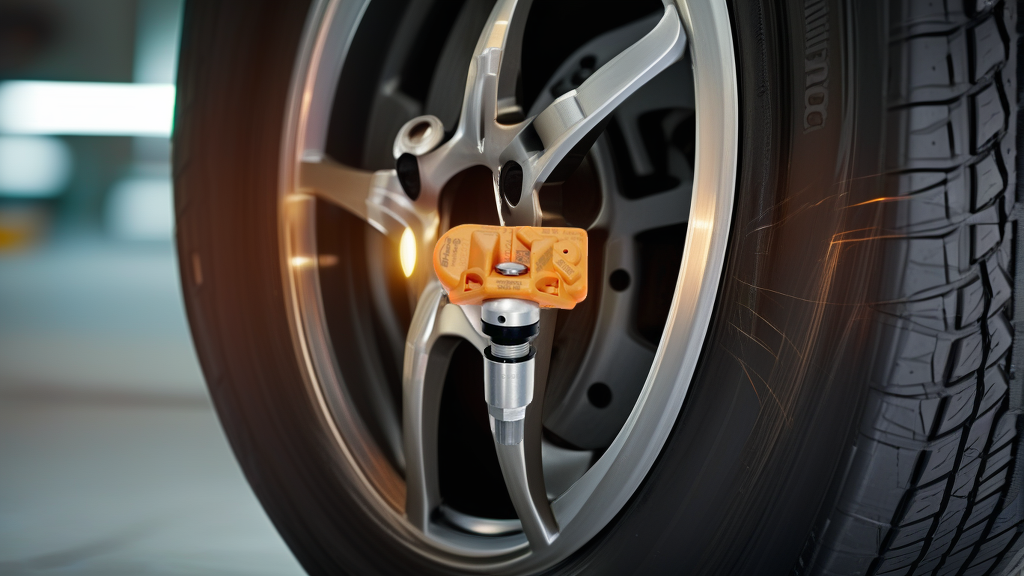
What a Relearn Actually Does
Each TPMS sensor broadcasts two things on a fixed frequency: a unique ID and the current pressure. The TPMS module keeps a list of IDs it trusts. If a wheel reports an ID that isn’t on that list, the module ignores it and lights the warning.
That creates two different jobs people both call “relearn”:
- Relearn / reset — the IDs haven’t changed; you just rotated tires or corrected pressure. The module is told to re-verify the wheels it already knows.
- Programming / ID write — a sensor was replaced, so a new ID exists that the module has never seen. This one almost always needs a tool.
Knowing which situation you’re in saves you an hour of pointless driving.
Tools You’ll Need
- A TPMS activation/trigger tool with 433MHz support (Autel, ATEQ, Bartec and similar all cover this band)
- An OBD-II scan tool or TPMS tool with OBD write capability for BMW/Mini platforms
- Accurate tire gauge and a compressor
- Access to your car’s reset menu (iDrive screen, BC stalk, or a dedicated reset button depending on model)
- Standard tire-shop tooling if you’re physically replacing the sensor
Method 1: Auto Relearn (Drive Cycle)
The simplest path, and only valid when the module already has the correct IDs stored.
- Set all four tires to the pressures on the door jamb placard — not to a number you saw online.
- Run the reset from the vehicle menu: on iDrive cars it’s under Vehicle Info → Vehicle Status → Tire Pressure → Reset; on older dash layouts it’s a reset button or a BC-stalk routine. Confirm the reset when prompted.
- Start the engine and drive continuously above roughly 20–25 mph (30–40 km/h) for about 10 minutes.
- The warning light clears once the module hears all four IDs reporting.
If the light comes back, or never clears, you’re not dealing with a reset — you’re dealing with an unregistered ID. Move to Method 3.
Method 2: Stationary Relearn (Trigger Tool)
This wakes each sensor and captures its ID without driving.
- Park with the ignition on, as directed by your tool’s on-screen prompt.
- Select the correct make/model/year in the tool.
- Hold the tool’s antenna flat against the tire sidewall near the valve stem, then press trigger.
- Wait for the confirmation — a horn chirp or an on-screen ID capture.
- Work through the remaining wheels in the order the tool displays.
- On BMW/Mini systems, the tool usually then asks you to connect to the OBD port to push those IDs into the module.
Clamp-in metal valve stems attenuate the signal, so keep the antenna on the sidewall next to the stem, not against the stem itself.
Method 3: OBD Relearn (ID Write)
This is the procedure that actually fixes a dead-sensor situation on most BMW and Mini platforms.
- Plug the tool into the OBD-II port under the driver’s side dash.
- Navigate to the TPMS or chassis/body menu and select Relearn / ID Write.
- When prompted, trigger each sensor in turn.
- Let the tool write the IDs and confirm completion.
- Clear any stored TPMS fault codes.
- Cycle the ignition off and on, then complete the drive cycle from Method 1 to finalize the learn.
| Method | When to use it | Tool required | Typical time |
|---|---|---|---|
| Auto relearn | Tire rotation, pressure reset, IDs unchanged | None | 10–20 min drive |
| Stationary relearn | Verifying sensors, capturing IDs before a write | Trigger tool | 5 min |
| OBD relearn | After replacing one or more sensors | Trigger + OBD write tool | 15–30 min |
Sensor Specs for This Platform
| Spec | Value |
|---|---|
| Brand | BH-Sens (Baolong Technology) |
| Frequency | 433MHz |
| Type | Clamp-in, pre-programmed |
| OE references | 36106856209, 36106881890, 6855539, 70735510 |
| Compatible brands | Alpina, BMW, Mini |
Buying the wrong frequency is the most common mistake here. If your original sensor or the module label says 433MHz, a 315MHz part will never register no matter how many times you trigger it.
Practical Notes Before You Start
- “Pre-programmed” means the sensor is already built to the correct protocol for the platform — it does not mean the car knows about it. A pre-programmed 433MHz unit such as RDE027V21 | BH-Sens 433MHz TPMS Tire Pressure Sensor | Fits Alpina, BMW, Mini | OE# 36106856209, 36106881890, 6855539 still needs its ID written on BMW/Mini systems.
- Check whether your car uses direct TPMS (valve-stem sensors) or indirect ABS-based monitoring. Indirect systems have no sensors in the wheels and no relearn at all — just a reset button.
- Don