
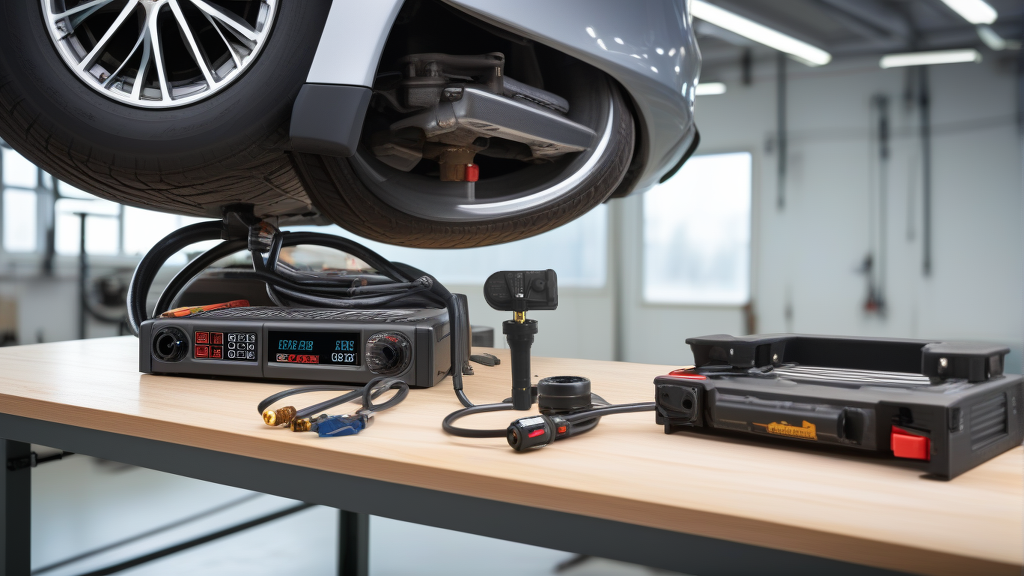
Read the Light Before You Touch Anything
The warning light is not one message — it is two, and they point in different directions.
- Solid light, no flashing. The system is communicating with all sensors. It has a pressure value it does not like, or a sensor has been flagged as faulted. Start with a gauge.
- Flashing for 60–90 seconds at startup, then solid. This is a system fault, not a pressure fault. One or more sensors are not reporting. Do not waste time adding air.
On a COSMOS with a direct TPMS system, each wheel has its own battery-powered sensor broadcasting on 433MHz to a receiver. That receiver feeds the body control module, which drives the dash light. Every fault below happens somewhere along that chain.
Cause 1: The Tire Pressure Is Actually Low
Start here because it is the cheapest thing to rule out.
Check all tires cold, with a real gauge — not the dash readout, which is only as accurate as the sensor reporting it. Remember that pressure drops roughly 1 psi for every 10°F of temperature fall. A car that was fine in September can throw a light on the first 25°F morning with no leak at all.
Also check the spare if your COSMOS monitors it, and check for slow leaks: a nail in the tread, a corroded bead, or a leaking valve core inside the sensor’s clamp-in stem. If you top up and the light returns within a week, you have a leak, not a sensor problem.
Cause 2: Dead Sensor Battery (The One Most Owners Miss)
TPMS sensor batteries are not serviceable. They are potted inside the sensor body and cannot be swapped like a watch battery. When they die, you replace the sensor.
Dead sensor battery symptoms, in the order they usually appear
- Intermittent light in cold weather first. Cold reduces battery voltage. The sensor still transmits at 70°F but drops out at 30°F. This is the earliest reliable warning.
- One wheel stops reading while the other three stay fine. The dash shows pressure for three corners and a blank, dash marks, or a frozen value for the fourth.
- The reading freezes or drifts. The last pressure value sticks on screen and never updates.
- The light clears after 15–20 minutes of driving, then returns. Motion and vibration temporarily wake a weak battery.
- The light becomes permanent. The battery is fully depleted.
Typical service life is 5–7 years, with 10 years as a realistic ceiling. If your COSMOS is on its original sensors and past the 6-year mark, a battery death is the single most probable cause of a persistent light with correct tire pressures.
Cause 3: Lost Registration or Relearn After Service
Every sensor has a unique ID. The vehicle only listens to IDs it has been taught. That registration is lost or broken by:
- Tire rotation (sensor moved to a different corner, IDs no longer match position)
- New sensor installation without a relearn
- A dead car battery or a module reset
- Low voltage during a jump start
Symptoms: the light comes on right after a tire shop visit, or after a battery replacement, with correct pressures and no other fault. The fix is a relearn — either the OE scan procedure or a TPMS activation tool that writes the new IDs. This is not something a generic OBD2 code reader can do.
Cause 4: 433MHz Signal Interference
This is the diagnosis people skip, and it is more common than most shops admit. The 433MHz band is shared with a lot of consumer electronics:
- Aftermarket key fobs and remote start systems
- Gate and garage openers in the same band
- Cheap USB chargers and dash cams plugged into the 12V socket
- LED retrofit bulbs and HID ballasts with poor shielding
- Tire sealant residue or a metal valve cap sitting over the antenna
Interference symptoms look different from a dead battery:
| Symptom | Dead battery | RF interference |
|---|---|---|
| Wheels affected | Usually one | Often two or more at once |
| Pattern | Worsens over weeks | Comes and goes, location-dependent |
| Cold weather | Makes it worse | No clear link |
| After driving past a specific spot | No change | Light clears or returns |
| After unplugging accessories | No change | Light often clears |
How to diagnose interference without a scan tool
- Drive a different route for two days. If the light stops appearing, you have a local transmitter, not a bad sensor.
- Unplug everything from the 12V socket and any USB ports. Drive a full cycle.
- Remove any aftermarket electronics wired near the dash, A-pillar, or wheel wells.
- Check for metal valve caps — they can detune the antenna on some clamp-in sensors.
- If none of that clears it, back-probe the receiver with a TPMS activation tool and confirm each sensor is transmitting at the wheel.
Cause 5: Physical Damage at the Valve
Clamp-in sensors fail mechanically as often as electrically. Watch for a corroded or bent valve stem, a cracked sensor body after a tire change, or a leaking valve core. Tire machines crush sensors regularly, and the damage often does not show up until the next time the tire is seated.
If the stem is wobbly, cracked, or the valve core hisses, the sensor is done regardless of battery condition.
Specs and Fitment for the COSMOS / Leapmotor Sensor
If your diagnosis lands on a dead or damaged sensor, the direct-fit replacement is BL-ST-085 | BH-Sens 433MHz TPMS Tire Pressure Sensor | Fits Leapmotor | OE# 8083010BA01 — a BH-Sens (Baolong Technology) 433MHz unit carrying OE number 8083010BA01, pre-programmed for Leapmotor applications.
| Spec | Value |
|---|---|
| Brand | BH-Sens (Baolong Technology) |
| Frequency | 433MHz |
| OE number | 8083010BA01 |
| Type | Clamp-in, pre-programmed |
| Compatible brand | Leapmotor |
| Dedicated OE fitments | 7 vehicle applications |
| SKU | BL-ST-085 |
Two things to know before ordering:
- “Pre-programmed” does not mean “self-registering.” The sensor ships loaded with the correct protocol and ID format, but your vehicle still has to learn that specific ID. Budget for a relearn at a shop with a TPMS tool, or confirm your tool supports the Leapmotor protocol.
- Verify by VIN, not by model year alone. With seven dedicated applications, the only safe check is your VIN or the OE number printed on the old sensor. Confirm the frequency matches — a 315MHz sensor will not talk to a 433MHz receiver, no matter how identical the housing looks.
Recommended Part
For a COSMOS or Leapmotor application running a dead or damaged 433MHz sensor, this is the direct-fit option: BL-ST-085 | BH-Sens 433MHz TPMS Tire Pressure Sensor | Fits Leapmotor | OE# 8083010BA01.
Replace sensors in axle pairs or as a full set when the originals are the same age. Mixing one new sensor with three six-year-old ones usually means you are back under the car in twelve months for the next one.
FAQ
How long do TPMS sensor batteries actually last?
Most direct TPMS sensors last 5–7 years in normal use, with 10 years as an outer limit. Heat and cold both shorten life, so cars in extreme climates often see the first failures closer to five years. Because the battery is sealed inside the sensor, replacement means fitting a new sensor, not a new battery.
Can I replace just the battery inside a TPMS sensor?
No. The battery is potted into the sensor housing to keep moisture out and survive wheel vibration. Cutting one open destroys the seal and usually the sensor. Any shop offering a “battery replacement” on a sealed sensor is either replacing the whole unit or doing something that will fail within a season.
Will the TPMS light turn off by itself after I install a new sensor?
Not usually. The new sensor transmits, but the vehicle is still listening for the old ID. You need a relearn or activation procedure to register the new ID to that wheel position. Once registered, most systems clear the light within a few minutes of driving above roughly 20 mph.
Can I keep driving with the TPMS light on?
Yes, but you lose your early warning for a real pressure loss. A sensor fault is an inconvenience; an ignored underinflation is a blowout risk and a fuel economy penalty. Diagnose it within a week or two rather than letting it ride until the next service.