
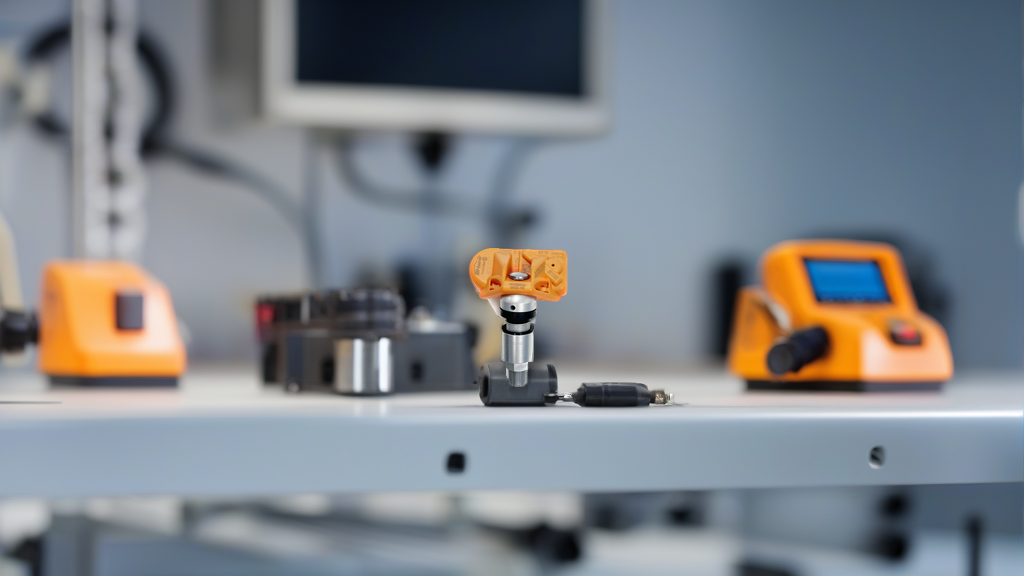
When you’re replacing a TPMS sensor on an E Class, the part listing looks simple: one sensor, one frequency, one OE number. But behind that simplicity are four specs that determine whether your tire pressure light resets or returns within a week. Here’s what actually matters.
Frequency Band: Why 433MHz Is the Standard
TPMS sensors in most European and Asian markets broadcast on 433MHz. North American vehicles more commonly use 315MHz, though many late-model imports stick with 433. On an E Class, you’ll almost always need 433MHz — the car’s receiver is tuned to that band and won’t see a 315MHz sensor.
The catch: frequency is just the carrier signal. Two sensors both transmitting at 433MHz can still be incompatible if they use different data encoding — that’s the protocol issue we’ll get to shortly.
Battery Life: Expect 5 to 7 Years
TPMS sensors have a sealed lithium battery. It’s not replaceable, so when the battery dies, you replace the whole sensor. Typical service life is 5-7 years of normal driving. Cold climates and frequent low-pressure warnings can drain it faster.
When you’re shopping for an E Class replacement, check the sensor’s age at install — a sensor that’s been sitting on a shelf for two years has already started its battery clock.
IP Rating: What the Numbers Mean
IP (Ingress Protection) ratings tell you how well the sensor resists dust and water. A clamp-in TPMS sensor sits inside the tire, where humidity and road splash are constant. The housing must keep them out.
| IP Rating | Dust Resistance | Water Resistance |
|---|---|---|
| IP54 | Limited — some dust ingress | Splash resistance |
| IP67 | Fully dust-tight | Immersion up to 1m for 30 min |
| IP68 | Fully dust-tight | Continuous immersion beyond 1m |
Most quality aftermarket sensors carry IP67. That’s sufficient for TPMS duty — the sensor is inside the tire, not underwater.
Protocol Compatibility: The Real Gotcha
Here’s where most mismatches happen. A 433MHz sensor broadcasts data packets at a specific rate and format. Mercedes uses a proprietary TPMS protocol, and a universal sensor only works if it’s programmed to that protocol. You have two options:
- Pre-programmed sensors — already set for specific OE part numbers. Drop-in fit for the listed vehicles.
- Programmable sensors — you set the protocol with a TPMS programming tool before install.
For BMW and Mini owners, the RDE027V21 | BH-Sens 433MHz TPMS Tire Pressure Sensor | Fits Alpina, BMW, Mini | OE# 36106856209, 36106881890, 6855539 is a pre-programmed 433MHz clamp-in sensor that covers 25 OE fitments (part numbers 36106856209, 36106881890, 6855539). That’s a clean example of how a single sensor can span multiple models — but only if the protocol matches.
For an E Class, always verify the OE part number against the sensor’s compatibility list. If the listing says “fits Mercedes E Class” and shows the right OE number, you’re set. If it says “universal,” you need a programmer.
Recommended Part
When you need a reliable 433MHz pre-programmed sensor for BMW, Mini, or Alpina applications, the RDE027V21 | BH-Sens 433MHz TPMS Tire Pressure Sensor | Fits Alpina, BMW, Mini | OE# 36106856209, 36106881890, 6855539 covers 25 vehicle fitments with a clamp-in design and sealed housing. For E Class, confirm your OE number and frequency before ordering.
FAQ
Can I use a BMW TPMS sensor on my E Class?
No — the mechanical mounting is similar, but the TPMS protocol and receiver programming differ by manufacturer. Always match the sensor to your E Class’s specific OE part number.
How do I know if my E Class uses 315MHz or 433MHz?
Check the old sensor’s label or your vehicle’s documentation. Most E Class models in non-North American markets use 433MHz, but you should verify the OE part number rather than guessing.
What does a dead TPMS sensor battery look like?
Your tire pressure light may come on intermittently, or the system may show “–” for a specific tire. The sensor can’t report pressure when its battery is gone.