
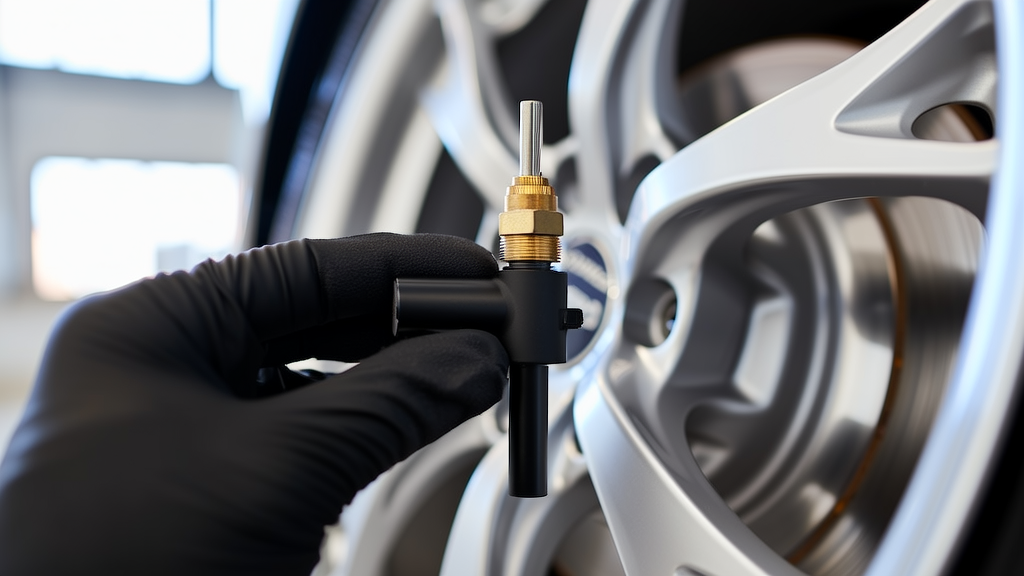
Frequency Band: The First Filter, Not the Last
Two bands cover almost every passenger car on the road: 315MHz and 433MHz. The split is regional. North American vehicles lean 315MHz; European and Asia-Pacific vehicles lean 433MHz. A Tang DM-i delivered in China is normally a 433MHz car, but export builds and mid-cycle changes exist, so never assume.
| Band | Typical region | Practical note |
|---|---|---|
| 315 MHz | North America, some JDM | Often paired with different ID conventions |
| 433 MHz | Europe, China, Asia-Pacific, most export markets | Dominant band for Chinese-built EVs and PHEVs |
A sensor on the wrong band does not “sort of work.” It transmits into a receiver that isn’t listening. The dash light stays on, and on some platforms you also lose the pressure readout on the cluster.
How to Confirm Your Band Without Guesswork
- Pull one wheel and read the label on the old sensor body — the frequency is usually printed next to the part number.
- If the label is gone, run the OE number through a cross-reference database or scan the sensor ID with a TPMS tool.
- Compare the number you find against the OE list on the replacement part. Numbers must match, not just the band.
On the TANG DM-I, the sensor IDs are paired to the vehicle’s receiver set. A 433MHz sensor from a different platform can broadcast on the same carrier and still be rejected — which is exactly why the OE number matters more than the frequency.
Battery Life: Rated vs Real
TPMS sensors use a sealed lithium cell, usually 3V, soldered in at the factory. You cannot swap the battery, so the battery is the service life of the sensor.
- Rated life: most OEM and quality aftermarket sensors are quoted at 5–10 years.
- Real life: driven by how often the sensor transmits, and by heat.
Sensors sleep when the wheel is stationary and wake on rotation or a pressure-change trigger. That means a high-mileage commuter car cycles the battery harder than a garage-kept weekend car. Heat is the bigger killer: brake heat and summer road temperatures degrade the cell faster than cold climates do. A sensor that lives in a hot, high-mileage environment can fail noticeably earlier than its rating.
Practical rule: if one sensor dies at year six or later, replace all four. The remaining three are on the same clock, and you will be paying for a second mount-and-balance job within a year otherwise.
IP Rating: What IP67, IP68 and IP69K Actually Cover
TPMS sensors live inside a wheel, so they see road spray, salt, mud and wheel cleaner. The IP number tells you what the sealed housing survives.
| Rating | Protection | Real-world meaning |
|---|---|---|
| IP67 | Dust tight, immersion to 1m for 30 min | Fine for normal road use |
| IP68 | Continuous immersion at a manufacturer-specified depth | Better for flooded roads, deep puddles |
| IP69K | Resists high-pressure, high-temperature water jets | Useful if you pressure-wash wheels at close range |
Two things the rating does not cover. First, the valve stem seal — a hardened rubber grommet or a cracked stem leaks air no matter how good the sensor body is. Second, the electronics are sealed, but the battery is still aging. Always fit a new service kit (grommet, washer, nut or screw) with a new sensor.
Protocol and ID Compatibility: Where Cheap Sensors Fail
433MHz is only the carrier. On top of it sits a modulation scheme, a data frame format and a unique sensor ID. When the vehicle learns a sensor, it is learning that ID and validating that frame.
There are three fitment styles in the aftermarket:
- Universal / blank sensors — need a programming tool to write a protocol and ID. Flexible, but you must own or borrow the tool.
- Pre-programmed sensors — the ID set is already written for a defined OE number range. No programming required on covered vehicles.
- Cloned OEM sensors — copy the ID from the original. Works, but requires the original still readable.
Pre-programmed is the cleanest path for a shop or a competent DIY owner, because the failure point is removed. That said, many vehicles still need a relearn or activation trigger after installation — a quick drive cycle on some, a TPMS tool on others. Check the procedure for your model before you start.
Spec Sheet: BL-ST-039 433MHz TPMS Sensor
| Specification | Value |
|---|---|
| Brand | BH-Sens (Baolong Technology) |
| Frequency | 433 MHz |
| Type | Clamp-in, pre-programmed |
| OE numbers | E300019160, E300020260, H56A7920001AC |
| Compatible brands | Aeolus, Eπ, Mhero, Nammi, Voyah |
| Installation | Clamp-in stem; torque to your vehicle manual spec |
If your original sensor carries one of those OE numbers, this is a direct 433MHz replacement: BL-ST-039 | BH-Sens 433MHz TPMS Tire Pressure Sensor | Fits Aeolus, Eπ, Mhero, Nammi, Voyah | OE# E300019160, E300020260, H56A7920001AC. If you drive a Tang DM-i, run the OE number off your own sensor first — the Tang typically uses a different ID set, so do not assume a Dongfeng-family sensor will pair just because it is also 433MHz.
Recommended Part
For Aeolus, Eπ, Mhero, Nammi and Voyah applications running 433MHz, the BH-Sens BL-ST-039 is pre-programmed, clamp-in, and cross-referenced to the OE numbers above. Confirm your OE number and band, then order: BL-ST-039 | BH-Sens 433MHz TPMS Tire Pressure Sensor | Fits Aeolus, Eπ, Mhero, Nammi, Voyah | OE# E300019160, E300020260, H56A7920001AC.
FAQ
Does my Tang DM-i use 315MHz or 433MHz?
Most China-market Tang DM-i vehicles run 433MHz, but export builds and running changes exist. Do not rely on the region — read the label on your old sensor or scan it with a TPMS tool. That takes five minutes and prevents a return.
Can I replace just one sensor?
You can, and the system will work, provided the new sensor’s band, protocol and ID set are accepted by the vehicle. But if the originals are six or more years old, the other three are near end of life. Replacing all four in one mount-and-balance job is almost always cheaper than doing it twice.
Do pre-programmed sensors still need a relearn?
Often, yes. Pre-programmed means no protocol writing is needed; it does not mean the car accepts the new ID automatically. Some vehicles relearn after a short drive, others need a TPMS activation tool or an OBD relearn. Check the procedure for your model.
Will a 433MHz sensor from another brand work on my car?
Only if the protocol and ID set match what your receiver expects. Two sensors can share the 433MHz carrier and still be incompatible. Always match by OE number first, frequency second.